Rock garden ideas
Alpines die of wet, not cold. Get the drainage and the stone placement right and a rock garden looks after itself for years.
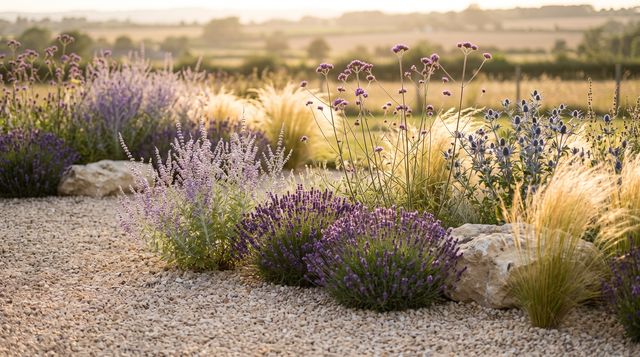
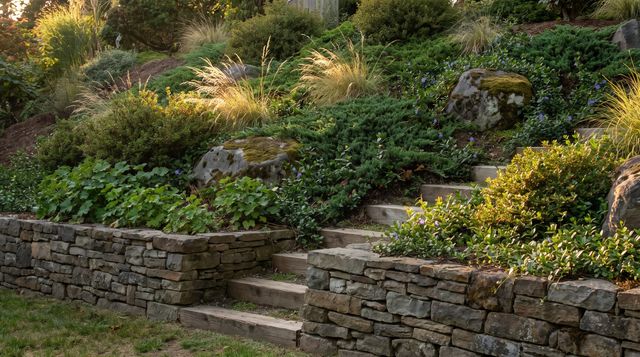
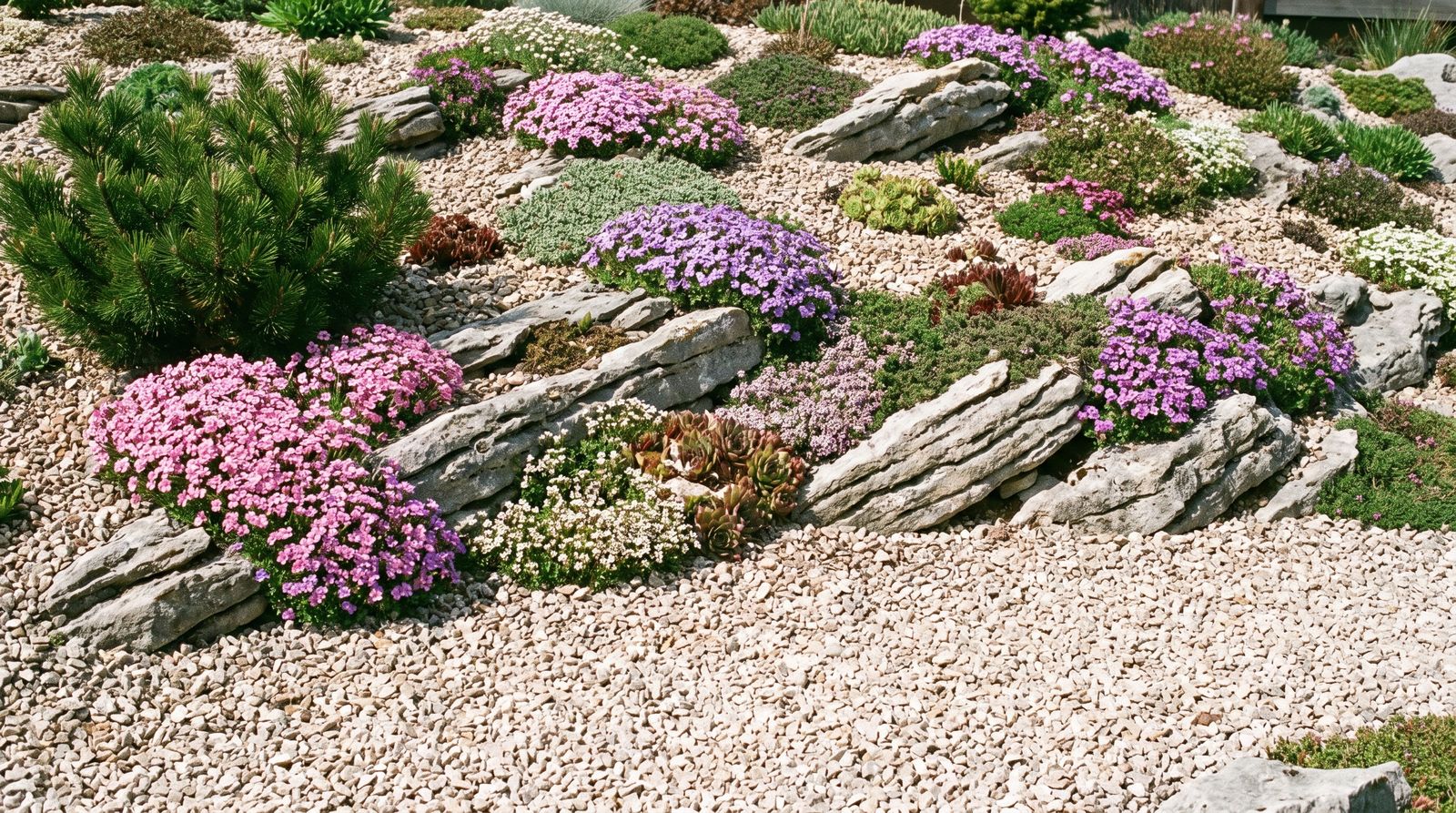
AI-generated concept image
- Light
- Full sun
- Water
- Low
- Upkeep
- Low
- Color
- Cool
- Planting survives
- −13 °F / −25 °C
Getting it right
Use one type of stone, ideally from a local quarry, and bed each piece about a third into the ground with the layers running the same way; mixed rock types are the giveaway of an amateur rock garden. Make the planting mix roughly half sharp grit and half topsoil, then top it with about 2 inches (5 cm) of chips of the same stone. Plant into the gravel rather than onto it, and keep the crown of every alpine sitting slightly high so water always drains away from it.
How to plan it
Pick the spot: full sun, good air movement and, ideally, a gentle slope that already drains. A south- or west-facing bank is perfect. Avoid the low point of the yard and the shade of trees; falling leaves smother small alpines and hold moisture against their crowns.
Build it as an outcrop, not a pile. Set the largest stones first at the base, tilted back into the slope, then step smaller stones up and back so they look like one layer of rock coming to the surface. Fill the pockets between them with the gritty mix and plant into those pockets, with mat-forming plants such as creeping thyme and creeping phlox where they can spill over a stone.
Upkeep is mostly weeding for the first two years, until the plants knit together, plus topping up the stone chips. Trim rock cress, candytuft and creeping phlox lightly after flowering to keep them tight, and pull any seedling that crowds a slower plant.
Plants that work
| Plant | Type | Light | Water | Height | Hardy to |
|---|---|---|---|---|---|
| Hens and chicksSempervivum tectorum | Succulent · Evergreen | Full sun | Low | 3–6 in (8–15 cm) | −22 °F / −30 °C |
| Goldmoss stonecropSedum acre | Succulent · Evergreen | Full sun | Low | 2–4 in (5–10 cm) | −22 °F / −30 °C |
| White stonecropSedum album | Succulent · Evergreen | Full sun | Low | 2–6 in (5–15 cm) | −22 °F / −30 °C |
| Mossy saxifrageSaxifraga × arendsii | Perennial · Evergreen | Partial shade | Moderate | 4–8 in (10–20 cm) | −13 °F / −25 °C |
| Rock cressAubrieta deltoidea | Perennial · Semi-evergreen | Full sun | Low | 4–6 in (10–15 cm) | −13 °F / −25 °C |
| Maiden pinkDianthus deltoides | Perennial · Semi-evergreen | Full sun | Low | 6–10 in (15–25 cm) | −22 °F / −30 °C |
| Sea thriftArmeria maritima | Perennial · Evergreen | Full sun | Low | 6–10 in (15–25 cm) | −22 °F / −30 °C |
| Creeping thymeThymus serpyllum | Groundcover · Evergreen | Full sun | Low | 2–4 in (5–10 cm) | −22 °F / −30 °C |
| Dalmatian bellflowerCampanula portenschlagiana | Perennial · Semi-evergreen | Partial shade | Low | 4–8 in (10–20 cm) | −13 °F / −25 °C |
| Evergreen candytuftIberis sempervirens | Perennial · Evergreen | Full sun | Low | 8–12 in (20–30 cm) | −13 °F / −25 °C |
| Creeping phloxPhlox subulata | Groundcover · Semi-evergreen | Full sun | Low | 4–6 in (10–15 cm) | −22 °F / −30 °C |
| Alpine asterAster alpinus | Perennial · Deciduous | Full sun | Low | 6–10 in (15–25 cm) | −31 °F / −35 °C |
| Mugo pinePinus mugo | Conifer · Evergreen | Full sun | Low | 3–10 ft (1–3 m) | −40 °F / −40 °C |
| Blue fescueFestuca glauca | Grass · Evergreen | Full sun | Low | 8–12 in (20–30 cm) | −22 °F / −30 °C |
Surfaces and materials
- Boulders
- Crushed granite
- Dry-stacked stone wall
- Stepping stones
- Gravel mulch
- Slate chips
Works well when
- The soil is thin and poor
- The soil is sandy and free-draining
- The ground slopes steeply
- It gets sun for most of the day
- You want low maintenance
Think twice when
- The ground stays wet after rain
- It is shaded for most of the day
- The soil is heavy clay
Common questions
What's the difference between a rock garden and rock landscaping?
Rock landscaping usually means gravel or river rock used instead of lawn or mulch. A rock garden is a planted feature: stone and grit built up to grow small alpine plants that need sharp drainage. You can combine both, with a rock garden as the focal point in a gravel yard.
What rocks should I use?
One type of local stone in a range of sizes, with a few pieces big enough to need two people to move. Local stone matches its surroundings and costs less to deliver; mixing sandstone, granite and lava rock is what makes a rock garden look artificial.
Do rock gardens need landscape fabric?
Not under the planting. Fabric stops plants rooting and spreading, and soil builds up on top of it anyway. Clear perennial weeds thoroughly before you build, and rely on a deep layer of stone chips to suppress new ones.
Can I build a rock garden on clay soil?
Yes, but build up rather than down. Raise the whole feature 12 inches (30 cm) or more above the clay with a gritty mix, so water drains out of the root zone instead of sitting in it.
See a rock garden on your own photo
Take a photo of the space as it is today and compare the redesign side by side with the original.

Scan to install