Rooftop garden ideas
A rooftop garden is an engineering problem before it's a design one: load, wind, drainage, and how anything gets up there in the first place.
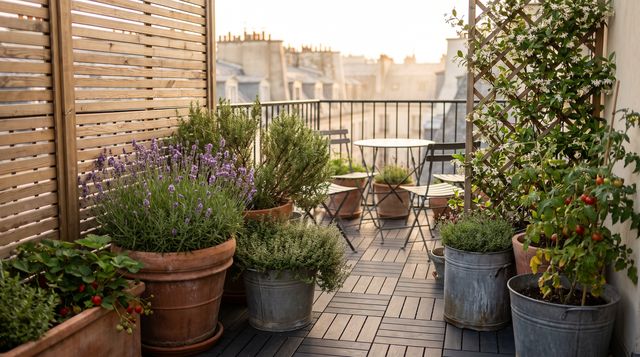
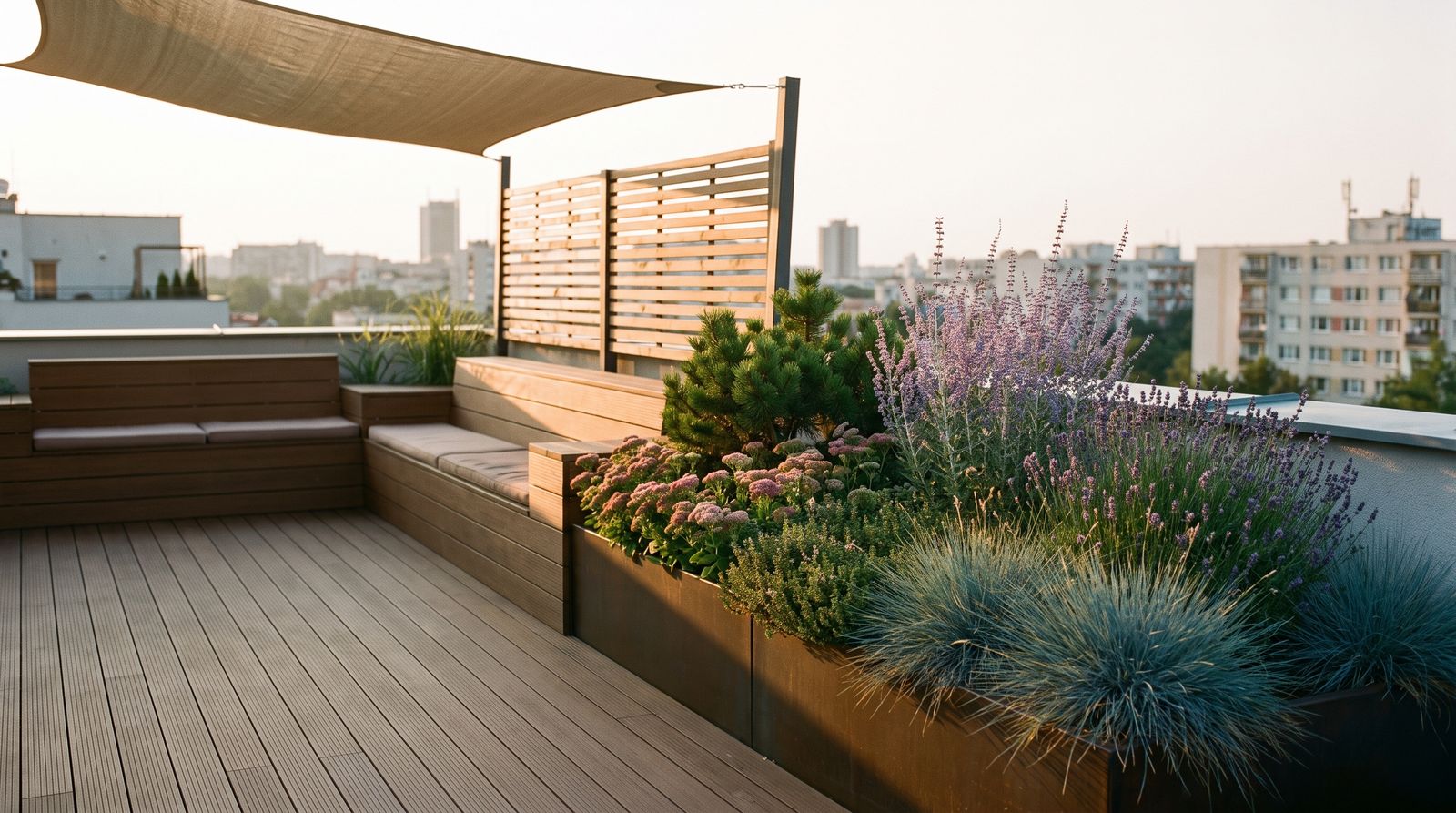
AI-generated concept image
- Light
- Full sun
- Water
- Low
- Upkeep
- Medium
- Color
- Neutral
- Planting survives
- 14 °F / −10 °C
Getting it right
Establish the load allowance before you draw anything, because wet soil weighs roughly 100 pounds per cubic foot (about 1,600 kg per cubic meter) and that one number decides the whole scheme. Use lightweight mix, choose deep narrow planters over shallow wide ones, and set them along structural edges where the roof is strongest. Assume constant wind: low, tough, small-leaved planting, everything anchored, nothing light enough to travel. Then check how a 6-foot (2 m) planter actually reaches the roof before ordering it.
How to plan it
Have a structural engineer or the building manager confirm the load allowance, the waterproofing and the drain locations before you plan anything. Landlord, condo board or HOA approval usually applies too, and many cities require a permit for rooftop decks, pergolas and railings.
Keep the weight low and near the edges: lightweight potting mix, fiberglass or aluminum planters, pavers on pedestals or composite decking over the membrane, and green-roof sedum trays for large planted areas. Leave drains and access hatches clear.
Plan for full sun and wind. The plants on this page, stonecrops, sea thrift, lavender, Russian sage and mugo pine among them, handle heat, drought and exposure. Drip irrigation on a timer is close to essential on a roof, where containers can dry out in a day.
Plants that work
| Plant | Type | Light | Water | Height | Hardy to |
|---|---|---|---|---|---|
| White stonecropSedum album | Succulent · Evergreen | Full sun | Low | 2–6 in (5–15 cm) | −22 °F / −30 °C |
| Hens and chicksSempervivum tectorum | Succulent · Evergreen | Full sun | Low | 3–6 in (8–15 cm) | −22 °F / −30 °C |
| Sea thriftArmeria maritima | Perennial · Evergreen | Full sun | Low | 6–10 in (15–25 cm) | −22 °F / −30 °C |
| Blue fescueFestuca glauca | Grass · Evergreen | Full sun | Low | 8–12 in (20–30 cm) | −22 °F / −30 °C |
| Mexican feather grassNassella tenuissimaInvasive in parts of the US. Check your state's list. | Grass · Semi-evergreen | Full sun | Low | 16–24 in (40–60 cm) | −4 °F / −20 °C |
| English lavenderLavandula angustifolia | Shrub · Evergreen | Full sun | Low | 16–28 in (40–70 cm) | −4 °F / −20 °C |
| Russian sageSalvia yangii | Shrub · Deciduous | Full sun | Low | 3–4 ft (0.8–1.2 m) | −13 °F / −25 °C |
| Mugo pinePinus mugo | Conifer · Evergreen | Full sun | Low | 3–10 ft (1–3 m) | −40 °F / −40 °C |
| New Zealand flaxPhormium tenax | Perennial · Evergreen | Full sun | Moderate | 5–8 ft (1.5–2.5 m) | 14 °F / −10 °C |
| Creeping thymeThymus serpyllum | Groundcover · Evergreen | Full sun | Low | 2–4 in (5–10 cm) | −22 °F / −30 °C |
| Ornamental onionAllium hollandicum | Bulb · Deciduous | Full sun | Low | 3–3 ft (0.8–1 m) | −22 °F / −30 °C |
| Showy stonecropHylotelephium spectabile | Perennial · Deciduous | Full sun | Low | 16–24 in (40–60 cm) | −22 °F / −30 °C |
Surfaces and materials
- Composite deck
- Green roof trays
- Zinc planters
- Slatted wood screen
- Shade sail
- String lights
- Gravel mulch
Works well when
- There is a structural weight limit
- The site is open and windy
- It gets sun for most of the day
- You eat outside in the evening
- Watering is restricted in summer
Think twice when
- There is no vehicle access
- There is no outdoor spigot
- The budget is tight
Common questions
Do I need permission for a rooftop garden?
Usually. Landlords, condo boards and HOAs typically have to approve it, and many cities require a permit for decks, railings, pergolas or anything that adds load to the roof. Check before buying materials.
What are the lightest planters?
Fiberglass, plastic and fabric grow bags, filled with a lightweight mix containing perlite or pumice. Terracotta and concrete planters look good but add a lot of weight before any soil goes in.
What plants survive on a roof?
Plants built for sun, wind and drought: stonecrops and hens and chicks, sea thrift, blue fescue, lavender, Russian sage and mugo pine. Tall plants and big soft leaves get battered by the wind.
How do I water a rooftop garden?
Install drip irrigation on a timer, fed from a hose bib on the roof if there is one. Without it, containers in full sun can need water every day in midsummer.
See a rooftop garden on your own photo
Take a photo of the space as it is today and compare the redesign side by side with the original.

Scan to install